Calculate Your Savings HERE
Boxes Created 1600000000
90000000 CO₂ Saved (lbs)
4518639.77 Trees Saved



Packaging is often treated as a small part of the fulfillment process, but the way a business approaches packaging can shape how the operation runs from end to end. When packaging processes are difficult to adapt or control, they can introduce friction that impact efficiency across the warehouse.
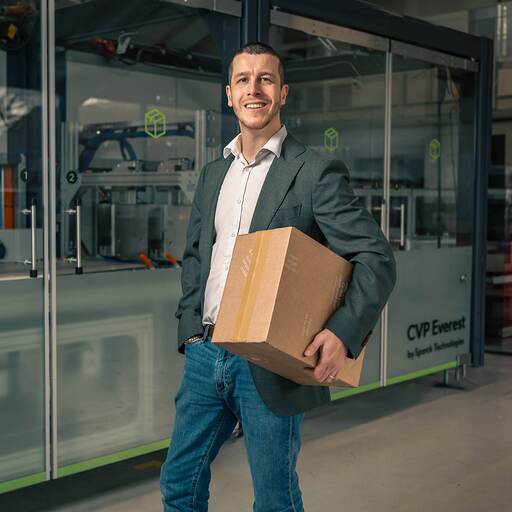
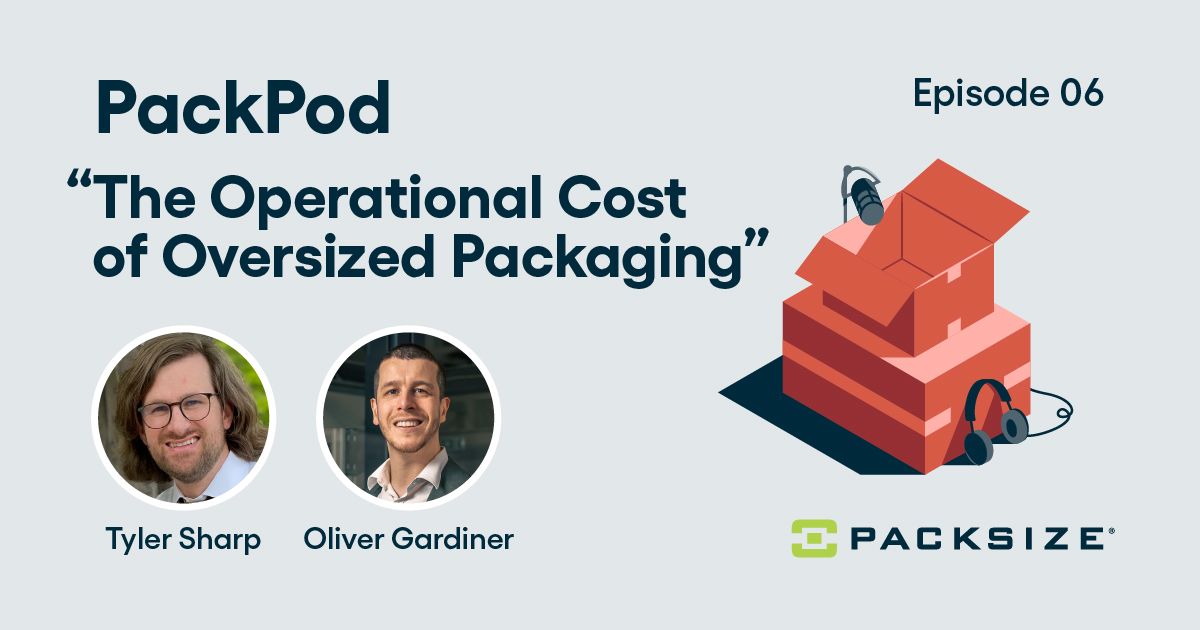
Join Tyler Sharp, Sr. Manager of Global Product Development, and Oliver Gardiner, European Solutions Engineering Manager, as they explore the connection between packaging and operational efficiency. From pack station performance and labor to warehouse space, damage risk, transportation, and changing order profiles, they discuss the challenges that can arise when packaging isn’t designed to keep pace with the operation.
In this episode of PackPod, Tyler and Oliver explain why the right packaging approach creates a more predictable, efficient, and scalable fulfillment operation.
Tyler Sharp: Welcome to the next edition of the Packsize Podcast. My name is Tyler Sharp. I'm on our Global Product Management team, and I'm joined today by Oliver, who leads our Solutions Engineering team in Europe. Is that right, Oliver?
Oliver Gardiner: Hey, Tyler. Yes. My name is Oliver Gardiner. I'm the European Solution Manager, leading a team of talented Solutions Engineers here in Europe who help our customers meet their goals with right-sized packaging automation.
I think this podcast is interesting. It creates an interesting dynamic between you and mI—you being in the U.S. and me in Europe. So let's see how we get on.
Tyler Sharp: The topic for today is the hidden costs of oversized packaging.
To start, Oliver, what are the key factors you see driving companies toward right-sizing their packaging?
Oliver Gardiner: It's an interesting question. From my experience, it's rarely one driver. Usually there's a single trigger, but it's followed by multiple realizations. It’s always an interesting scope, because as you peel back the layers of an operation, you discover more. Most operations are different in one way or another, which keeps things interesting.
One of the main drives is labor, that comes to my mind, and that’s essentially the cost. Here in Europe, labor costs have increased year after year, and in many cases companies struggle to recruit altogether, so they typically go the agency staff route. So these are typical challenges that we find.
An associated hidden cost that relates to labor is that, in my experience, when some of our customers go down the right-sizing route, they typically find an increase in staff retention as well, which is great to see. Obviously, automation brings a reduction in the strain to their staff and the outcome is typically very positive within the work environment. This is what I’m typically seeing as most of the drivers. I think regulations are increasingly coming into the spotlight as well with EPR, where essentially companies can be penalized for excessive packaging. I think what that creates is a lot of companies are trying to position themselves for the future.
Is this typically what you find in the U.S., Tyler? Is that about what you are seeing as well?
Tyler Sharp: Yes. Similar. I'd say, some nuances there. We don't have as much regulation, I would say, driving right- sized packaging. We do have dimensional weight from carriers, primarily, is a big driver over here that's maybe a little bit different than Europe, which is just where the larger a package gets, the more it costs. So, I have a different approach, but a similar goal, I think, in mind. But labor's another big one, like you said. So, yeah, pretty similar.
Oliver Gardiner: Yeah, it’s very interesting. You guys have got more space than us as well. So space is always a constraint here.
Tyler Sharp: Yeah, zooming in a little bit, I guess, to a warehouse—is there something about oversized packaging that you found that makes pack stations, traditional pack stations less efficient than if you can right-size your packaging?
Oliver Gardiner: Yeah, absolutely. For me, oversized packaging really begins at the pack stations, as you alluded there. When an operator needs to compile a fixed-size box together, there's an array of, obviously, decisions that need to be made, hand movements, judgments on the size of those boxes, from building them and applying void fill as well. What's interesting is that void is, it takes a few seconds to place inside a box, but you times that by thousands of orders, and essentially, it's definitely a drag on throughput. More rare is typically more taping, sealing, etcetera, and it compounds over time.
But what I find also is that when businesses really want to scale and increase, that's very, very hard to do that with fixed-size boxes. And as I said earlier, in Europe, warehouse space is hard to come by. It's very, very costly. So you wanna utilize that square meter as much as you can. Going down the road of right-sizing and automation is typically how you get to that position.
Tyler Sharp: Something else I've noticed too, typically, you'll have the people that design the pack station, they'll set up the proper work instructions for operators. Right? They'll say, “This is how you use the void fill. This is how much tape you should be using,”all these things. “This is how you should select the box size.” But then if you observe operators in their natural environment, they tend to do whatever path of least resistance. So if it's looking like, “That size might not fit, I'm gonna go to the bigger one just in case,” and then they grab the bigger box. And then they either underfill or overfill the void fill, and then they maybe use too much or too little tape.
Oliver Gardiner: It’s definitely a good point, and if you don’t put that void fill in the correct place or enough of it, you just essentially create movement inside the box, and that's when you get damages, etcetera. So it's very, very hard to control, but it is a very good point. Yeah. Absolutely. Yeah. Cool.
Tyler Sharp: What other areas in the warehouse have you seen that lead to maybe some hidden costs, like operational expenses, things like that? anything else, or is it largely just pack stations where you see?
Oliver Gardiner: There's an array of situations that causes issues there. With fixed size-boxes, and especially in the e-comm industry, which a lot of my experience is in e-comm. But what I find is that, year on year, the SKU ranges change. The dynamic in terms of the box sizes, the order profiles, etcetera, changes. And it's really, really difficult to match that with fixed-size boxes. You typically find that businesses will have different product ranges, and they'll try and fit them in the old boxes that they used before. And it really shows a peak, and that's the critical time of here where you need to perform.
And essentially, in my opinion, that creates a ripple effect. And what's interesting is that those inefficiencies, they rarely stay at the pack bench. They essentially travel through the operation downstream, which is interesting. Extra air inside a box will take up warehouse space, pallet space, trailer fill is not as good. But when businesses transition to right-sizing, the operation essentially becomes a lot more predictable, especially in e-comm. And predictability in an unpredictable kind of space, which is, you know, considering the order profiles, is what businesses need. So, yes, scalability is very difficult with right-sizing. But for you guys in The US. I mean, you've got plenty of experience, I think, as well, Tyler, in factory spaces and that sort of industry. I mean, what are you typically finding in that industry? Something similar to this?
Tyler Sharp: Yeah. I'd say, one of the big areas for at least in the US that I've seen kinda outside of the e-commerce space is in pallet locations. So, especially if a customer is using a bunch of different box styles or box sizes to accommodate their different products and SKU mix. They may have 100 different pallet locations for boxes. So I guess that's not oversized packaging. That's maybe more of the benefit on the on-demand side of things, but that's largely where I see kind of the biggest impact to the on-demand space.
Oliver Gardiner: Yeah. Well, with right-sizing, you can fit more on a pallet, of course.
Tyler Sharp: Curious if, in Europe, you've had any conversations with some of the carriers like DHL or anyone? And do they have any hidden costs, or is there anything that we know about the carriers and their appetite to get to right-size packaging?
Oliver Gardiner: I always come back to e-comm. But when you go to right-sizing, you're essentially reducing air within the box, the profile of the box decreases. But obviously, the underlying principle behind the carrier is to sell space in a vehicle. And when you right-size, you get more parcels per truck. It's better density, less damages, so less returns, fewer vehicles, all that sort of thing. But, essentially, the shipper and the carrier, in my opinion, they want the same thing, and the same thing being a more efficient carrier network, which essentially, in my eyes, is a win- win. And of course, with going back to regulations, this is becoming more critical as well. But you mentioned earlier that you've got volumetric weights in the US. So for you guys, this is gonna be absolutely critical, isn't it?
Tyler Sharp: Yeah. Yep. It directly affects the bottom line for sure.
Oliver Gardiner: Absolutely. The other thing that I find really interesting, and there's plenty of examples that I've had experience with in Europe, is that, one of the benefits, obviously, we touched on this, is that when you go to a platform like Packsize, obviously, you're reducing the size of the boxes. But, essentially, that solution, it comes with a whole array of data. And when you have that data to understand what size boxes, what the weights of those parcels are each time that you're sending out, although volumetric weights isn't that common here in Europe, it gives you a way that you can negotiate with your carrier. You've got the data to back up what you're actually sending through the network. We've had many examples of customers that have utilized the power of that data to get the most out. And as you say, is reducing the bottom line, which is critical.
Tyler Sharp: Well, any other questions or comments you wanna make, Oliver?
Oliver Gardiner: Not really from my side. I think hidden costs there, we've touched on those in terms of what we've seen and had experience with. It's been really interesting to understand your perspective in the US. And certainly with factory space and how that works in that operation as well. So, I really hope that this has been beneficial for everybody watching, and I appreciate everybody's time.
Tyler Sharp: Yeah. Thank you.